

Your business needs money. That’s clear. But should you grab a traditional loan or set up a line of credit? Get this wrong, and you’ll either waste thousands on interest you didn’t need to pay, or worse—miss payments because you chose rigid terms when flexibility was essential.
Here’s what most business owners don’t realize: these two products work in completely opposite ways. One hands you cash upfront and expects steady payments regardless of your sales. The other sits quietly until you need it, charging you only for what you actually use.
Let’s break down exactly how each one works and when you’d choose one over the other.
What Is a Small Business Loan?
Think of a term loan as a financial commitment similar to your mortgage. The lender approves you for a specific dollar amount—let’s say $75,000. That full sum hits your business checking account, usually within a week of closing. Starting immediately (sometimes after a short grace period), you’ll make monthly payments that chip away at both the principal and interest.
Most term loans run anywhere from 12 months to a full decade. Equipment financing sometimes stretches even longer since the equipment itself serves as collateral. Your payment stays the same each month: $1,456.81 due on the 15th, every single month, whether you had a fantastic sales month or barely broke even.
This predictability helps with financial planning. You know exactly what you owe and when it’ll be paid off.
Business owners typically pursue term loans for major, one-time expenses. Maybe you’re buying out a partner’s stake in the company. Perhaps you found the perfect storefront and need renovation funds. Or you’re scaling up production and need three new machines installed. These are situations where you know the exact cost upfront and how that investment will generate revenue over time.
Traditional banks offer the most competitive rates—sometimes as low as 5-7% for borrowers with excellent credit and strong financials. Credit unions often match these rates for members. Online lenders approve applications faster (sometimes within 48 hours) but typically charge 9-20% or higher because they accept riskier borrowers.
Here’s the catch: once you’ve paid off that $75,000, you’re done. The account closes. Need money again next year? You’ll submit a completely new application, go through underwriting again, and start from scratch.

What Is a Business Line of Credit?
A business line of credit works like having a credit card, except the limits are higher and the rules are more business-friendly. Let’s say you get approved for $100,000. That money doesn’t land in your account automatically. Instead, you can pull from it whenever you want, up to that $100,000 ceiling.
You might draw $15,000 in April to stock up on inventory before your busy season. Then in June, after customers have paid, you pay back that $15,000. Come August, you need $28,000 for a different expense—no problem, you draw again. The line stays open and available (usually for 12-24 months initially), and you can tap it repeatedly without reapplying.
Interest charges apply only to whatever balance you’re currently carrying. If you borrowed that $15,000 for two months, you’d pay interest for two months. The remaining $85,000 of available credit? Costs you nothing in interest, though some lenders charge small monthly maintenance fees just for keeping the line active.
This revolving access makes lines of credit perfect for businesses facing timing mismatches between expenses and revenue. Landscaping companies need equipment and supplies in March but don’t see most of their revenue until May through September. Retailers buy holiday inventory in September and October but collect revenue in November and December. Consulting firms often wait 30-60 days for client payments while still covering weekly payroll.
Lenders typically review your line annually. Performing well? They might increase your limit. Revenue declining? They could reduce it or decline to renew entirely.
Key Differences Between Loans and Lines of Credit
Both products put cash in your business, but they operate according to completely different rules that dramatically affect your costs and flexibility.
Funding Structure and Disbursement
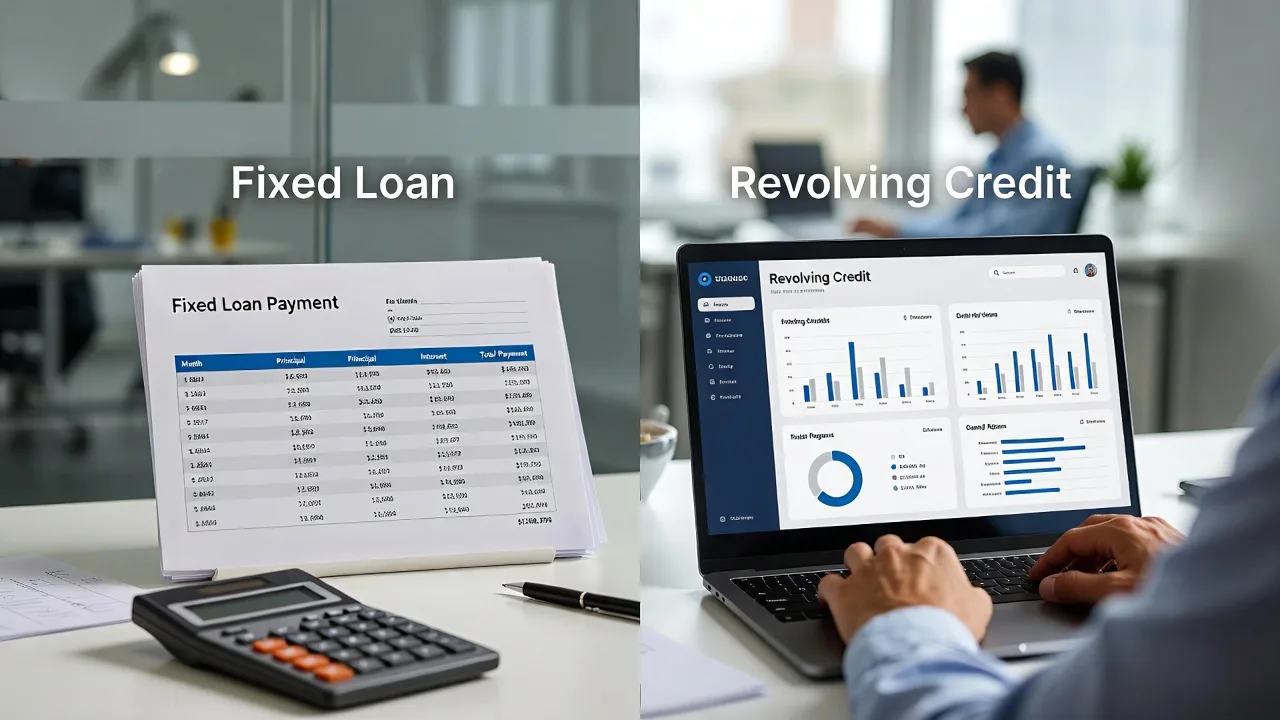
When a term loan gets approved, the entire amount transfers to your account in one lump sum. You’re buying a $120,000 piece of manufacturing equipment? That $120,000 arrives whether you’re ready to spend it or not. This works great when you’re writing a check to a seller or contractor who needs payment immediately.
Lines of credit flip this model. Your lender approves you for, say, $60,000 in available credit. You might draw $8,000 this week, another $12,000 next month, or nothing at all during quarters when cash flow is strong. Most lenders provide a checkbook, debit card, or online transfer portal so you can access funds within minutes of deciding you need them.
Why does this matter? Interest charges. Term loan borrowers pay interest on the complete amount starting immediately—even if half that money sits unused in their account for two months. Line of credit users pay interest exclusively on their outstanding balance. Borrow nothing? Pay nothing (except potentially small maintenance fees).
Repayment Terms and Schedule
Term loans follow an amortization schedule that your lender provides upfront. Every payment includes a portion applied to principal and a portion covering interest. Early payments are mostly interest; later payments chip away more principal. Miss a payment? You’re in default, and your credit score takes a hit.
Lines of credit offer much more breathing room. During the draw period (when you can actively borrow), many lenders require only interest payments on your balance. Want to pay down principal? Go ahead—most lines don’t charge prepayment penalties. Tight month coming up? Make the minimum interest payment and move on.
After the draw period expires, you’ll enter a repayment phase where you pay down whatever balance remains over a set timeframe. But during the active period, you control the pacing.
This flexibility saves businesses during rough patches. Your biggest client pays 45 days late, throwing off your whole cash flow? With a line of credit, you make the smaller interest-only payment and catch up next month. Term loan holders don’t get that option—the full payment is due regardless of circumstances.
Interest Rates and Costs
Term loans generally cost less in annual percentage rate terms because lenders face less uncertainty. They know you borrowed $80,000 and will repay it over 60 months. This predictability lets them offer rates around 6-12% for creditworthy borrowers.
Lines of credit typically charge 10-25% annually (sometimes even higher for newer businesses) because lenders can’t predict your borrowing patterns. Will you draw the full amount immediately? Use it sporadically? Leave it untouched for months?
But APR doesn’t tell the complete story. Lines of credit also come with fees that term loans avoid:
– Draw fees: some lenders charge $25-75 each time you access funds
– Maintenance fees: annual or monthly charges ($50-300) just for keeping the line available
– Unused line fees: penalties if you don’t borrow at least 50% of your limit within a certain timeframe
Here’s a real scenario: A bakery needs $40,000 for three months to purchase equipment for a large catering contract. A term loan at 8% over five years costs roughly $8,100 in total interest. A line of credit at 18% repaid in three months? About $1,800 in interest. The “expensive” line of credit saves $6,300 because the borrower repaid it quickly.
| Feature | Small Business Loan | Business Line of Credit |
|---|---|---|
| Funding Amount | Single lump sum, often $25,000-$500,000 | Revolving access up to your limit, commonly $10,000-$250,000 |
| Disbursement Method | Full amount transferred at closing | Pull funds as needed; unused portion stays available |
| Repayment Structure | Fixed monthly installments covering principal and interest | Flexible payments; often interest-only during draw period |
| Interest Calculation | Accrues on entire loan from disbursement | Charged only on your current outstanding balance |
| Typical Terms | Anywhere from 1-10 years | Draw period of 6-24 months, followed by repayment phase |
| Best Use Cases | Large purchases, expansion projects, acquisitions, equipment | Managing cash flow gaps, seasonal inventory, emergency expenses |
| Credit Requirements | Usually need 650+ for attractive rates | Often approved at 600+, though 680+ unlocks better terms |
| Approval Time | Ranges from 1-6 weeks depending on lender | Typically 1-3 weeks |
Requirements for Small Business Loans vs Lines of Credit
Lenders examine similar financial factors for both products, but they prioritize different elements depending on which one you’re applying for.
Term loan applicants should expect credit score minimums around 650 if you want competitive rates from traditional lenders. Online lenders might approve scores in the 580-620 range, but you’ll pay significantly higher interest. Your business needs at least two years of operating history in most cases, though some lenders make exceptions for borrowers with strong personal credit and substantial industry experience. Annual revenue expectations start around $100,000, though this varies based on how much you’re requesting.

Documentation gets extensive. Prepare to submit:
– Two to three years of business tax returns
– Profit and loss statements, ideally broken down quarterly
– Balance sheet showing assets and liabilities
– Bank statements covering 3-6 months to demonstrate cash flow patterns
– Sometimes a detailed business plan explaining exactly how you’ll deploy the funds and generate returns
Larger loans—usually anything above $100,000—often require collateral. This might be business equipment, commercial real estate, inventory, accounts receivable, or even personal assets if business assets don’t cover the loan amount.
Personal guarantees are standard practice. You’re promising that if the business can’t repay, you will—even if that means going after your personal assets. Lenders also examine your personal credit history and may set minimum requirements for personal net worth or liquid assets.
Lines of credit demand similar documentation but emphasize different aspects of your finances. Some lenders approve businesses with only 12 months of revenue if your monthly bank deposits show strong, consistent patterns. They care more about cash velocity—money flowing in and out regularly—than long-term profitability projections.
Credit score minimums typically start around 600-625 for initial approval. Hit 680 or above, and you’ll see noticeably better rates and terms. Revenue requirements run lower than term loans—often starting at $50,000 annually—because line amounts tend to be smaller.
Collateral requirements swing wildly between lenders. Some offer unsecured lines up to $50,000 or even $100,000 for businesses with excellent credit and solid cash flow. Larger lines usually require a blanket lien (a claim against all your business assets) or specific collateral like equipment or receivables.
The application timeline moves faster for lines of credit because lenders focus on recent performance rather than detailed business plans and projections. They want evidence that cash moves through your accounts regularly, proving you can repay borrowed funds quickly rather than letting balances sit for months.
Application Process for Each Financing Option
Getting approved for a term loan starts with crystal-clear documentation of what you need and why. Lenders respond better to specific requests: “We need $175,000 to purchase a competing business that will add $400,000 in annual revenue” beats “We need growth capital” every time.
Assemble your financial documents—tax returns, financial statements, bank statements covering the requested timeframe. Submit your application along with these supporting documents. The lender’s underwriting team dives into your numbers, examining your debt service coverage ratio (this measures whether your cash flow can handle the new payment). They’ll also evaluate collateral value if you’ve pledged assets.
Underwriting timelines vary enormously. Traditional banks might take 4-6 weeks, especially for larger amounts or complex situations. They’ll scrutinize every detail, ask follow-up questions about any anomalies in your financial statements, and possibly request additional documentation. Online lenders often render decisions within 2-5 business days, though their standards may be looser and their rates higher.
Questions will come. Why did revenue drop 15% in Q3 of 2023? What was that $45,000 expense in June? Where exactly will this money go, and how quickly will it generate returns? Prepare detailed answers.
Once approved, you’ll review the loan agreement carefully. This document spells out your interest rate, exact payment schedule, any prepayment penalties (watch for these—they can be expensive), financial covenants you must maintain (like minimum cash balances or maximum debt-to-equity ratios), and conditions that constitute default. After signing, funds typically arrive in 3-7 business days.
Lines of credit follow a similar but condensed path. You still provide financial documentation, but lenders zero in on recent bank statements showing your deposit and withdrawal patterns. They’re assessing whether revenue flows through your accounts consistently and quickly enough to support short-term revolving borrowing.
Many online lenders now offer integration with accounting platforms like QuickBooks or direct bank account connections. Grant them read-only access, and they’ll pull transaction data automatically rather than making you compile statements manually. This speeds up the process but requires comfort with giving lenders system access.
Approval usually takes 1-3 weeks. Once approved, you’ll receive access to funds through one of several mechanisms: a linked bank account where you can initiate transfers online, checks you can write against the line, or sometimes a debit card linked to the account. A few lenders deposit your full credit limit into a dedicated account, treating draws as transfers from that account to your operating account.
When to Choose a Loan vs When to Choose a Line of Credit
Your specific cash flow patterns, the purpose behind your borrowing, and how quickly you can convert that capital into revenue should drive your decision—not just which option has the lower interest rate advertised.
Go with a term loan when you’re funding a specific, substantial purchase that will create value over an extended period. A restaurant invests $90,000 in a complete kitchen renovation. That investment should boost capacity and revenue for years to come, making the fixed monthly payment manageable against the increased income.

Term loans also make sense for refinancing existing debt at better rates, acquiring another business, or funding expansion that needs several months to become cash-flow positive. You need patient capital that doesn’t demand rapid repayment.
Consider a construction company bidding on a municipal project. They need $200,000 in specialized equipment that the contract specifically requires. The contract spans 18 months and will generate enough revenue to cover loan payments comfortably throughout that period. A term loan matches perfectly—the equipment creates long-term value, and the contract provides predictable revenue to service the debt.
Choose a line of credit when your expenses and revenue run on different timelines. A wholesale distribution business purchases $85,000 in inventory during August and September to prepare for the holiday shopping season. Their retail customers buy in October and November but don’t pay invoices until January and February. Covering that 4-5 month gap with a term loan means paying interest long after converting inventory to cash. A line of credit lets them borrow in August, repay in January, and stop paying interest immediately.
Lines of credit excel for businesses experiencing seasonal revenue fluctuations, lengthy payment cycles (like net-60 or net-90 terms), or unpredictable but important expenses. A digital marketing agency delivers work monthly but waits 45-60 days for client payments. They can cover biweekly payroll using a line of credit, then repay it when client checks arrive.
Emergency preparedness represents another strong use case for lines of credit. Your primary delivery vehicle dies unexpectedly and needs a $7,000 repair. A major client offers you a time-sensitive bulk discount if you can pay upfront. A key supplier suddenly demands payment acceleration. These situations benefit from immediate capital access without the 2-4 week wait required for term loan approval.
Some sophisticated business owners maintain both strategically: a term loan for major capital investments combined with a line of credit for operational cash flow management. This approach provides structure for big, planned expenses and flexibility for day-to-day financial management.
Imagine a retail clothing boutique. They secure a $150,000 term loan to completely renovate their space, expand the showroom, and upgrade fixtures—an investment that will attract more customers and support higher pricing over the next 5-7 years. Simultaneously, they maintain a $40,000 line of credit to manage inventory purchases throughout the year and bridge gaps between seasonal peaks in November-December and May-June. The term loan’s predictable payment fits their improved baseline revenue. The line of credit prevents stockouts during crucial selling periods without forcing them to pay interest during slow months when they don’t need to borrow.
Business owners often choose financing based on what they can qualify for rather than what actually fits their cash flow reality. A term loan might advertise a lower rate, but if your revenue swings seasonally and you can’t consistently make fixed payments during slow periods, you’re building toward default. The financing structure needs to match your revenue pattern—not just chase the lowest interest rate on paper.
Sarah Chen, Director of Small Business Lending at Regional Business Finance Association.
FAQs
Absolutely—many businesses run both simultaneously and benefit from the combination. Lenders look at your total debt service capacity (can your cash flow handle all the payments?), so qualifying for one doesn’t automatically disqualify you from the other. You’ll need sufficient revenue and cash flow to demonstrate you can service both obligations comfortably. Some lenders might reduce your available line of credit if you take on a large term loan, but this depends on the specific lender and your overall financial strength. The strategy works well: use term loans for major investments with long-term payoffs, and maintain a line of credit for working capital flexibility.
Neither is universally easier—your specific business profile determines which path offers better odds. Lines of credit sometimes approve newer businesses (even those with just 12 months of revenue) if recent bank statements show consistent cash flow patterns. Term loans may be more accessible for businesses with valuable collateral but variable revenue since lenders can secure their position against physical assets. Your credit score matters for both, but lenders weight factors differently: term loan underwriters emphasize long-term stability and business plans; line of credit underwriters focus on recent cash flow velocity. If you’ve got 18 months in business with strong monthly deposits, try a line of credit first. If you’ve got three years of profitable operations and equipment to pledge, you might find term loans more accessible.
No—interest charges apply exclusively to your outstanding balance. If your line has a $75,000 limit but you’ve only drawn $20,000, you pay interest on that $20,000. The remaining $55,000 available credit costs you zero in interest. However, watch for other fees. Some lenders charge monthly or annual maintenance fees (often $50-300) just for keeping the line open, regardless of usage. A few impose unused line fees if you fail to draw a minimum percentage (like 50%) of your limit within a certain timeframe. Read your credit agreement carefully to understand all fees beyond interest—they can add up and make an “unused” line surprisingly expensive.
You technically can, but it’s a financially inefficient choice. Lines of credit carry significantly higher interest rates than term loans because they’re designed for short-term, revolving borrowing. Using one for long-term investments means paying premium rates (sometimes 15-25%) for years when a term loan might cost 7-10%. Additionally, lenders review lines annually and may reduce your limit or decline renewal if they see you maintaining consistently high balances—they’ll interpret this as a sign of financial distress rather than healthy working capital management. If you need money for 12+ months, the math almost always favors a term loan despite its less flexible structure.
Term loans and lines of credit solve fundamentally different business problems. Term loans deliver structured, predictable capital for planned investments that generate returns over time. Lines of credit provide flexible access for managing cash flow volatility and seizing time-sensitive opportunities.
Start by analyzing your business’s revenue patterns over the past year. Do sales stay relatively consistent month-to-month? Fixed loan payments won’t create problems. Do you have seasonal peaks and valleys? Fluctuating revenue demands the flexibility only a line of credit provides.
Look beyond the interest rate advertised in bold on the lender’s website. Calculate what you’ll actually pay based on how long you need the money. A 22% line of credit repaid in three months costs substantially less than a 9% term loan carried for five years—if you genuinely only need the funds briefly.
Consider where your business stands in its lifecycle. Established businesses with strong credit histories and solid financials access better rates on both products. Newer businesses might find lines of credit more accessible because lenders emphasize recent cash flow over lengthy operating history.
Don’t make financing decisions based purely on what you can get approved for. Just because a lender offers you a $125,000 term loan doesn’t mean you should take it if you really need $40,000 for four months. You’ll waste thousands on unnecessary interest. Similarly, don’t try funding equipment purchases through a line of credit just because approval came faster—you’ll pay premium rates for years when patient, cheaper term loan money would’ve worked better.
Understand that both tools serve legitimate purposes in business finance. Neither is inherently superior. The question isn’t “which is better” in the abstract—it’s “which fits my specific situation right now.”
Pull your cash flow statements from the previous twelve months and study them carefully. When do cash crunches typically hit? Do client payments lag significantly behind your expense timing? Are there predictable inventory needs that spike seasonally? Your actual cash flow patterns should dictate your choice more than any other factor—more than rates, more than approval speed, more than what your business neighbor uses.
Many thriving businesses use both strategically over time. They might take a term loan for a major expansion, then set up a line of credit six months later for ongoing operational cash flow needs. Or they might start with a line of credit to manage early growth volatility, then graduate to term loans as revenue stabilizes and they’re ready for significant capital investments.
The right financing decision comes from honest assessment of your business’s cash flow reality—not wishful thinking, not what sounds impressive, and not just whatever carries the lowest advertised rate. Match the financing tool to your actual revenue patterns and borrowing needs. Get this right, and you’ll save thousands while maintaining healthy cash flow. Get it wrong, and you’ll either pay excessive interest or struggle with payments that don’t match your income timing.