

When you’re ready to borrow money for your business, the interest rate will determine whether that loan becomes a smart investment or a financial burden. Most owners rush through this part—they’re so focused on getting approved that they barely glance at the rate they’re offered.
Here’s the thing: a difference of just one percentage point adds up faster than you’d think. Take a $100,000 loan over five years. At 7%, you’ll pay around $19,800 in interest. Bump that to 8%, and you’re looking at $21,600. That extra $1,800 might not sound dramatic, but it’s money you could’ve spent on marketing, equipment, or hiring.
Throughout this guide, we’ll walk through exactly how lenders decide what rate to offer you, which factors push that number up or down, and what you can actually do about it. You’ll also see real businesses and the rates they received, because percentages in a vacuum don’t mean much until you see them applied to situations that might mirror your own.
How Small Business Loan Interest Rates Explained
Think of your interest rate as the price of renting money. Lenders look at how likely you are to pay them back, then charge accordingly. If they think you’re a safe bet, you’ll pay less. If your business looks shaky, expect a higher price tag—assuming they’ll lend to you at all.
Fixed vs. variable—your first fork in the road. With a fixed rate, you know exactly what you’ll owe every month from day one until you’ve paid off the loan. No surprises, no recalculating your budget when economic winds shift. Variable rates move with market benchmarks like the prime rate or SOFR. When the Federal Reserve adjusts rates, yours follows within a month or so.
Variable rates typically start lower, which looks appealing. But here’s the catch: that 6% intro rate could creep up to 9% if the Fed decides inflation needs taming. Fixed rates cost more upfront because you’re paying for certainty.
Interest rate vs. APR—this trips people up constantly. Your interest rate shows what you’re charged on the principal you borrowed. Simple enough. But APR bundles in all the extra costs: origination fees, closing expenses, annual charges. When a lender advertises “6% interest,” the actual APR might hit 7.2% after you factor in a 3% origination fee. Always ask for the APR when comparing offers. That’s where the real cost lives.
Lenders build your specific rate through internal pricing models. They start with a baseline tied to current market rates, then layer on risk adjustments based on your credit, your industry, how long you’ve been operating, what collateral you’re putting up. A bank might use the current prime rate—let’s say 7.5%—then add anywhere from 2 to 5 points depending on how confident they feel about getting repaid.
Watch out for factor rates, especially with merchant cash advances or ultra-short-term products. Instead of a traditional interest rate, you’ll see something like “1.3 factor.” That means for every dollar you borrow, you’ll repay a dollar thirty. Sounds straightforward, but when you calculate what that translates to over six months, you’re often looking at APRs above 60%. Way higher than a conventional loan.
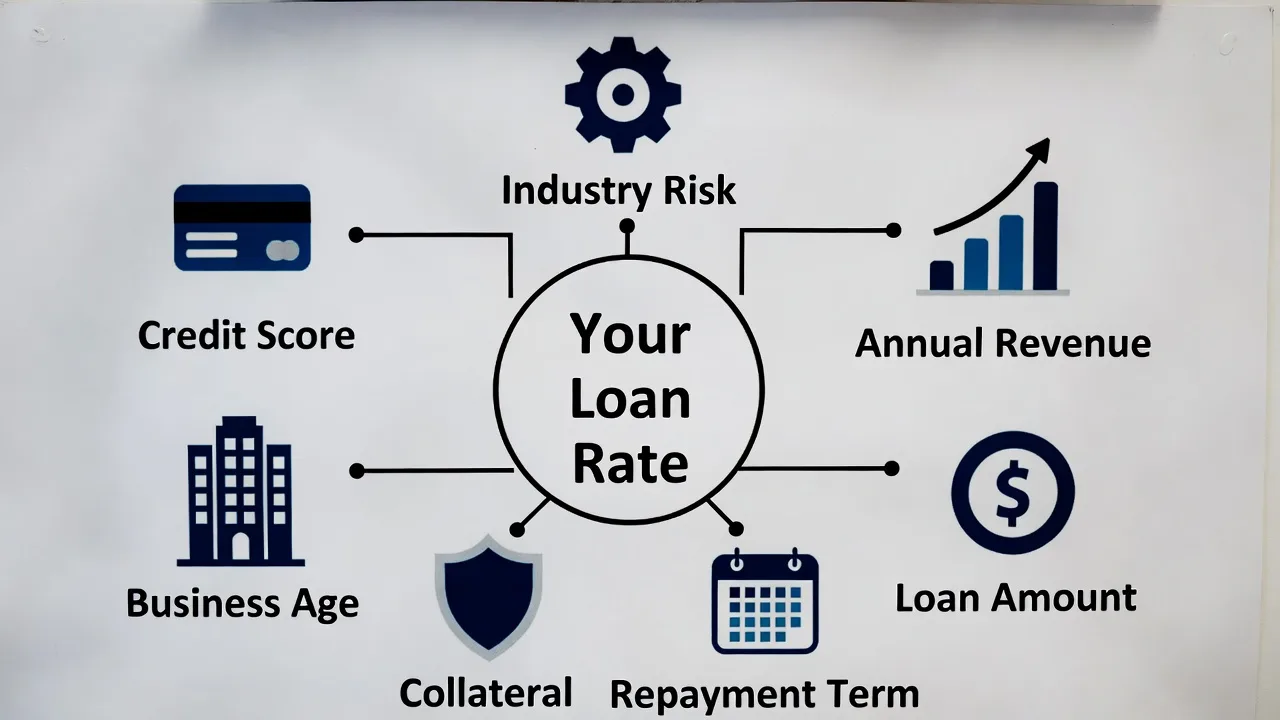
The Factors Behind Your Small Business Loan Interest Rate
Lenders don’t just throw darts at a board. They’re examining specific pieces of your financial life, and understanding what they care about most helps you improve your position before applying.
Credit Score and Business Credit History
Your personal FICO score carries enormous weight, especially if you’ve been in business less than five years. The magic number many lenders look for is 680. Above 740, you’re in excellent territory. Below 600, most traditional lenders won’t even continue the conversation.
Business credit scores matter more as you mature. Dun & Bradstreet scores run from 0 to 100, while Experian and Equifax use their own scales. Once you’ve been operating for a few years and building vendor relationships, these scores show how you actually manage business obligations versus personal ones.
Any blemishes on your credit report cost you. A 90-day late payment from two years back might tack on half a percentage point. Bankruptcies within the past seven years can add 3 to 5 points to your rate, or disqualify you entirely from conventional options. High credit card utilization—running your cards near their limits—signals financial stress even if you’re making payments on time.
Time in Business and Revenue
Lenders really don’t like funding brand-new businesses. Most traditional banks want at least two years of operating history, with many preferring three or more. Why? Because startups fail constantly. Statistics vary by industry, but something like half of new businesses don’t make it past five years.
If you’ve only been around for 18 months, expect to pay 2 to 4 percentage points more than an identical business that’s been running for five years. Assuming you can even find a traditional lender willing to consider you.
Revenue proves you’ve got the cash flow to make payments. As a rough guideline, lenders prefer seeing annual revenue at least 1.5 times your loan request. Want to borrow $50,000? They’d like to see $75,000 or more in annual sales, ideally with stable or growing trends quarter over quarter.
Seasonal businesses get extra scrutiny. If your revenue pattern shows 70% of sales concentrated in three months, lenders worry about how you’ll make payments during the dry spell. You’ll need deeper cash reserves or solid collateral to ease those concerns.
Loan Amount and Repayment Term
Bigger loans carry more risk for the lender, so they typically charge more. A $250,000 loan will usually have a higher rate than a $50,000 loan to the exact same borrower. The bank has more capital on the line for a longer period.
Term length works the same way. Five years gives a lot more time for things to go sideways compared to two years. Economic downturns, industry disruptions, personal emergencies—all have more opportunity to interfere with repayment over a longer timeline. Lenders charge a premium for that extended exposure.
Yes, shorter terms mean higher monthly payments. But you’ll pay dramatically less interest overall. That $100,000 loan at 8%? Over three years, you’ll pay roughly $13,600 in interest. Stretch it to five years and you’re at $24,300. Many owners choose the longer term anyway because manageable monthly payments matter more for cash flow than total cost. That’s not wrong—just understand the tradeoff you’re making.
Collateral and Personal Guarantees
Secured loans—where you pledge specific assets—will always beat unsecured loans on rate. If you default, the lender can seize your equipment, property, or inventory to recover their money. That safety net reduces their risk substantially.
Real estate-backed loans usually score the lowest rates because property values stay relatively stable and appraisals are straightforward. Equipment financing rates run a bit higher since machinery loses value and resale markets fluctuate. Inventory and receivables make shakier collateral because they change constantly.
Personal guarantees are virtually unavoidable for small business loans. You’re promising to repay from personal assets if the business can’t cover it. These don’t lower rates as much as physical collateral does, but refusing to provide one almost guarantees rejection. Lenders interpret unwillingness to personally back your business as a red flag about your confidence.
Putting up 20% to 30% of the loan amount as collateral can shave 1 to 2 percentage points off your rate compared to borrowing unsecured. On a $200,000 loan over five years, that translates to $4,000 to $8,000 in savings.
Average Interest Rates by Loan Type
What you’ll actually pay depends heavily on which type of financing you choose and who’s offering it. Here’s the current landscape in 2026:
| Loan Type | Rate Range You’ll See | How Long | Credit Score Minimum | Works Best For |
|---|---|---|---|---|
| SBA 7(a) Loans | 11.5%–14.5% | 10–25 years | 680+ | Long-term investments, real estate, working capital when you’re not in a rush |
| SBA 504 Loans | 6.5%–8.5% | 10–25 years | 680+ | Buying commercial property, expensive equipment |
| Traditional Bank Term Loans | 7.5%–12% | 1–10 years | 700+ | Established companies making significant purchases or consolidating debt |
| Online Lenders | 10%–99% | 3 months–5 years | 600+ | Quick funding, when your credit isn’t perfect, short-term needs |
| Business Lines of Credit | 9%–25% | Revolving access | 650+ | Covering temporary cash flow gaps, seasonal expenses, emergency buffer |
| Equipment Financing | 6%–20% | 2–7 years | 650+ | Buying machinery, vehicles, technology |
| Invoice Financing | 15%–60% APR | 30–90 days | 600+ | B2B companies with customers who pay slowly |
SBA loans get their favorable rates because the Small Business Administration backs a portion of each loan, which cuts the lender’s risk. You don’t borrow directly from the SBA—banks and credit unions issue these loans following SBA guidelines. The 504 program focuses specifically on real estate and major equipment, explaining why those rates sit lower than the more flexible 7(a) program.
Traditional banks compete well on price but move slowly. You’re looking at four to eight weeks from application to getting money in your account. Regional banks and credit unions frequently beat national banks by a quarter to half a percentage point, particularly when you already bank with them.
Online lenders have flipped the traditional model—speed and convenience trump low rates. Many approve applications within 48 hours and fund within a week. You’ll pay considerably more for this, sometimes seeing rates in triple digits for very short-term products. This makes sense when the opportunity cost of waiting exceeds the borrowing cost. If you need inventory tomorrow to fulfill a major contract, paying 35% for three months might be smarter than losing the deal entirely.
Requirements to Qualify for Lower Interest Rates
Lenders respond to preparation. Taking these steps before you apply shifts the odds in your favor:
Work on your credit score first. Pull your personal and business credit reports at least 90 days before applying. Look for errors—wrong accounts, incorrect balances, paid-off debts still showing open. Dispute anything inaccurate immediately because resolution takes weeks. Pay down credit cards below 30% of your limits, and closer to 10% if possible. Don’t close old accounts even if you’re not using them. The age of your credit history helps your score.
Get your financial documents organized. You’ll need two to three years of business tax returns, current profit and loss statements, balance sheets, and bank statements. Having these ready and clearly labeled signals that you run a professional operation. Messy or incomplete financials make lenders question your management capabilities.
Make sure your books reconcile before submitting anything. When your tax returns and bank statements don’t match up, underwriters dig deeper and sometimes walk away entirely. If you’ve been aggressive with tax deductions, understand that lenders add back certain expenses to calculate your actual cash flow for repayment.
Improve your debt service coverage ratio. This measures whether you generate enough cash to cover your debts. The calculation divides your annual net operating income by your total annual debt payments. Lenders typically want 1.25 or higher, meaning you produce $1.25 in cash for every dollar you owe in debt service. Below 1.0 indicates you’re not generating enough to cover what you already owe, let alone a new loan.
You can strengthen this ratio by increasing revenue, trimming expenses, or paying down existing debts before applying for new ones. A business with $150,000 in net operating income and $100,000 in annual debt obligations has a 1.5 DSCR—comfortably above minimums and a sign of financial health.
Put more money down if you can. Offering 20% to 30% as a down payment shrinks the lender’s exposure and often unlocks better pricing. This works especially well for equipment financing or real estate. You’re proving you’ve got skin in the game while reducing the loan-to-value ratio.
Time your application strategically. When the Federal Reserve holds rates steady or cuts them, you’ll find better deals than during aggressive rate-hike cycles. If you can wait a few months to avoid an anticipated rate increase, the savings over the loan term might justify the delay.
Look into industry associations or CDFIs. Some trade organizations negotiate member benefits including better loan access. Community Development Financial Institutions focus on underserved markets—low-income areas, minority-owned businesses—and sometimes offer below-market rates specifically to support economic development in those communities.
Small Business Loan Interest Rate Examples
Percentages on a page don’t mean much until you see how they actually play out. Here’s what different business owners experienced:
Example 1: Restaurant Owner Expanding to a Second Location
Maria’s been running a successful restaurant for six years, pulling in $850,000 annually. She needs $150,000 to open a second location. Her personal credit score sits at 720, business credit at 75. She owns the building her current restaurant operates from and offers it as collateral.
A regional bank approves an SBA 7(a) loan at 12.25% over 10 years. Monthly payments run $2,065. Total interest over the life of the loan: $97,800. Her established track record, collateral, and solid credit put her in the middle-to-lower range for SBA pricing.
Example 2: E-commerce Startup Needing Inventory Capital
James launched an online retail business 14 months ago. First-year revenue hit $220,000 and he’s growing quickly. A wholesale opportunity just landed—he needs $40,000 for inventory but must move fast. Personal credit score: 680. Minimal business credit history. No collateral beyond the inventory itself.
Traditional banks pass due to his limited operating history. An online lender approves a 12-month term at 28% APR with a 5% origination fee. Monthly payments: $3,780. Total interest and fees: $5,360. That’s expensive, but the wholesale contract nets him $18,000 in profit. Even after paying borrowing costs, he comes out ahead—and he couldn’t have seized the opportunity any other way.
Example 3: Manufacturing Shop Buying New Equipment
Susan operates a metal fabrication business she started 12 years ago. Annual revenue: $1.2 million. She needs $200,000 for a CNC machine. Personal credit score: 760. Business credit: 82. Strong profitability for years. The equipment itself will secure the loan.
A credit union offers equipment financing at 7.8% for five years. Monthly payments: $4,012. Total interest: $40,720. The combination of excellent credit, long operating history, and the equipment serving as collateral lands her near the bottom of available rates. She also explores an SBA 504 loan at 7.2%, but the paperwork and longer closing timeline make the credit union option more attractive.
Example 4: Landscaping Company Using a Flexible Credit Line
David runs a landscaping operation now in its fourth year. Annual revenue: $420,000, heavily seasonal. He needs flexible access to $50,000 for equipment repairs and covering payroll during slow winter months. Credit score: 695.
A bank approves a revolving line of credit at 11.5% variable (prime plus 4 points). He only pays interest on amounts he actually draws. During a three-month stretch, he pulls $30,000, then repays it as spring revenue rolls in. Interest for that period: roughly $860. The variable rate means costs could climb if the Fed raises rates, but the flexibility matches his seasonal business model better than a fixed term loan would.
How to Compare and Choose the Best Rate
The lowest advertised number doesn’t automatically make something the best deal. Buried fees, prepayment penalties, and restrictive terms can make an attractive-looking offer expensive in practice.
Figure out the total cost. Add up everything you’ll pay over the complete loan term—all interest, every fee, each charge. A 10% loan with zero fees beats a 9% loan carrying a 5% origination fee if you’re borrowing short-term. Online calculators help, but verify by examining the actual payment schedule in the loan documents.
Read the prepayment penalty section carefully. Some lenders charge you for paying off the loan early because they’re losing expected interest income. These penalties often kick in during the first two to three years and can hit 2% to 5% of your remaining balance. If you anticipate strong cash flow or plan to refinance when rates drop, avoid loans with steep early payoff penalties.
Understand what you’re personally liable for. Nearly all small business loans require your personal guarantee, but the extent varies. Some limit your liability to specific assets. Others give lenders access to essentially everything you own. Know what you’re putting at risk before signing.
Make sure you’re comparing similar structures. A three-year loan at 9% has higher monthly payments but lower total interest than a five-year loan at 8%. Decide what matters more for your situation—minimizing the monthly burden or reducing total cost—then compare offers with matching term lengths.
Try negotiating, especially with banks you already use. If you maintain business accounts somewhere or have previous loan history with them, ask about reducing the rate by a quarter to half a percentage point. Bring competing offers to strengthen your position. Credit unions often negotiate more readily than large national banks with rigid pricing matrices.
Clarify whether your rate is locked. If you’re quoted a rate today but won’t close for several weeks, verify whether that number is guaranteed. Rates can increase during the underwriting period, leaving you stuck with worse terms than you expected. Rate locks protect you for a specific window, usually 30 to 60 days.
Common mistakes? Focusing only on the monthly payment (which hides long-term costs), not understanding the difference between simple interest and factor rates, and failing to think through how variable rates might change. A loan that fits comfortably in your budget today could become unaffordable if rates jump two percentage points next year.
Most business owners don’t realize that improving their credit score by just 20 to 30 points before applying saves them more than any negotiation after receiving an offer. Lenders use rigid pricing models based on credit tiers. Moving from a 679 to 680 score can literally drop you into a different rate category and save thousands of dollars.
Robert Chen
FAQs
“Good” shifts depending on what type of loan you’re getting, your credit situation, and what’s happening in the broader economy. In 2026, rates below 10% for standard term loans generally mean you’ve got strong credit and favorable terms. SBA loans in the 11% to 13% range are competitive. Anything under 8% is excellent and typically requires top-tier credit plus strong collateral. Online lenders and alternative financing frequently exceed 20%, which isn’t necessarily terrible if you need speed and convenience, but shouldn’t be your first stop if you qualify for traditional options.
Yes. Interest you pay on business loans typically counts as a deductible business expense, which reduces your taxable income. If you borrowed $100,000 and paid $8,000 in interest during the year, you can deduct that $8,000—potentially saving $2,000 to $3,000 in taxes depending on your bracket. The principal repayments aren’t deductible, though. Just the interest portion. Keep detailed records that separate interest from principal in your accounting system. For specific situations—especially mixed-use loans or using home equity for business purposes—talk to a tax professional about how to handle it correctly.
Absolutely, especially with banks and credit unions where you’ve got an existing relationship. Bring competing offers to show you’ve shopped around. Lenders might shave 0.25 to 0.5 percentage points off to win your business, particularly if you’re a strong borrower. Online lenders typically have less wiggle room since they use automated pricing models, but even they’ll sometimes negotiate on larger loans. Your leverage increases with better credit, stronger financials, and willingness to provide collateral or put more money down. Don’t just accept the first number they give you.
Federal Reserve policy shifts directly impact variable-rate loans, usually within 30 days. When the Fed raises its benchmark rate, the prime rate increases correspondingly, and your variable rate adjusts upward. Fixed-rate loans aren’t affected once you’ve closed on them, but new fixed-rate loans become more expensive in rising-rate environments. If the Fed cuts rates, new borrowers benefit from lower costs while existing variable-rate borrowers see their payments decrease. The Fed raised rates dramatically from 2022 through 2023 to fight inflation, then started cutting again in late 2025. These cycles create windows where borrowing costs shift significantly within just a few months.
Your interest rate shows the percentage charged on the money you borrowed. APR takes that interest rate and adds in all the fees—origination charges, closing costs, annual fees, and other lender charges—then expresses everything as an annual rate. So a loan advertised at 7% interest with $3,000 in fees on $100,000 might actually have a 7.8% APR. The APR gives you a more accurate picture of what you’re really paying and lets you compare offers fairly. Always ask for the APR when evaluating loans, not just the interest rate. Federal law requires lenders to disclose it, but some marketing materials only highlight the lower interest rate number.
Pick a fixed rate when you need payment predictability and think rates will rise, or when you’re pushing the limits of your budget and can’t absorb payment increases. Fixed rates make more sense for longer terms—five years or more—since rate volatility increases over extended periods. Choose a variable rate when you expect to repay quickly, believe rates will fall, or when the initial savings are substantial enough to justify the risk. Variable rates work well for lines of credit you’ll pay off within months or when you’re planning to refinance before rates adjust significantly. Consider your risk tolerance and how stable your cash flow is. Businesses operating on thin margins should prioritize knowing exactly what they’ll owe each month.
The interest rate on your small business loan determines whether financing makes sense or becomes a financial drain. The gap between an excellent rate and an average one compounds over time—potentially costing tens of thousands on larger loans.
Your credit profile, business fundamentals, what you can pledge as collateral, and which type of loan you choose all influence the rate you’ll receive. Improving these factors before applying—even modest improvements—often delivers better terms than any negotiation after you’ve received offers. Spending 60 to 90 days strengthening your credit score, organizing financial documentation, and paying down existing debts can move you into a better pricing tier.
Look at total costs rather than fixating on interest rates or monthly payments alone. Account for all fees, understand whether your rate is fixed or variable, and read the details around prepayment penalties and personal guarantees. The cheapest loan doesn’t always come from whoever advertises the lowest rate.
Match your financing choice to what you actually need. SBA loans deliver excellent rates for patient borrowers who can handle paperwork and wait weeks for funding. Online lenders cost more but provide speed when timing matters. Equipment financing offers competitive rates when machinery secures the loan. Lines of credit provide flexibility for seasonal or unpredictable expenses.
Most importantly, borrow strategically rather than out of desperation. Businesses that apply from positions of strength—with organized financials, clear plans for using the funds, and realistic repayment projections—consistently secure better rates than those scrambling for emergency capital. Plan ahead, strengthen your financial position, and shop carefully to ensure the terms support your business growth rather than strain it.