

Choosing the wrong business loan can cost thousands of dollars in unnecessary interest and fees. A $50,000 loan with a 12% APR versus a 35% APR means the difference between paying $3,300 or $9,500 in finance charges over two years. Yet many business owners rush into the first offer they receive, focusing solely on approval speed or the friendliness of a loan officer rather than the actual cost and terms.
Smart comparison shopping requires understanding what you’re actually comparing, which factors matter most for your situation, and how to spot red flags that signal an expensive or restrictive loan product. This guide walks through the complete process of evaluating small business financing options to find the best fit for your company’s needs and qualifications.
Why Comparing Small Business Loans Matters
The small business lending market spans traditional banks, credit unions, SBA-backed lenders, online platforms, and alternative finance companies. Each operates with different underwriting criteria, pricing models, and product structures. A business owner who qualifies for an SBA 7(a) loan at 11% APR might also receive offers for a merchant cash advance at 60% APR or a short-term online loan at 40% APR—all for the same $75,000 in funding.
Cost differences directly impact your cash flow and profitability. A restaurant borrowing $100,000 to renovate its dining room will pay vastly different amounts depending on the loan structure. A five-year term loan at 9% costs roughly $2,075 per month with $24,500 in total interest. A three-year loan at 18% costs $3,610 monthly with $29,960 in interest. A nine-month loan at 30% costs $12,500 monthly with $12,500 in interest. Each scenario creates different cash flow demands and total costs.
Beyond price, unsuitable loan products create operational problems. A business with seasonal revenue that takes a loan requiring fixed daily or weekly payments may struggle during slow months. A company planning expansion that accepts a loan with strict covenants limiting additional borrowing may find itself unable to capitalize on growth opportunities.
Business owners often focus on whether they can get approved and how quickly they’ll receive funds, but the total cost of capital and repayment structure matter far more over the life of the loan. A difference of just a few percentage points in APR can mean tens of thousands of dollars on a six-figure loan.
Michael Chen, Senior Lending Advisor, National Small Business Association
Comparing options also reveals which lenders actually serve your business profile. A startup with six months of operating history won’t qualify for most traditional bank products but may find suitable options with online lenders or microloan programs. A business with $2 million in annual revenue and strong credit has leverage to negotiate better terms when banks compete for the relationship.

Types of Small Business Loans You Can Compare
Understanding the basic loan categories helps narrow your comparison to appropriate products for your situation and purpose.
Term loans provide a lump sum upfront with fixed monthly payments over a set period, typically one to ten years. These work well for specific investments like equipment purchases, real estate, major renovations, or business acquisitions. Traditional banks offer the lowest rates (6-12% APR) but require strong credit and financials. Online term loans fund faster with more flexible qualification but cost more (10-40% APR).
SBA loans are partially guaranteed by the Small Business Administration, allowing lenders to offer longer terms and lower rates than conventional loans. The 7(a) program provides up to $5 million for working capital, equipment, or real estate with terms up to 25 years and rates currently ranging from 11-13%. The 504 program finances commercial real estate and heavy equipment. SBA loans require extensive documentation and take 45-90 days to close but offer the best terms for qualified borrowers.
Business lines of credit function like credit cards, providing revolving access to capital up to a set limit. You draw funds as needed and pay interest only on the outstanding balance. Credit lines suit businesses with variable cash flow needs, seasonal inventory purchases, or unexpected expenses. Banks offer lines up to $250,000 at 8-15% APR for established businesses. Online lenders provide smaller lines ($10,000-$100,000) at 15-40% APR with faster approval.
Merchant cash advances (MCAs) provide upfront capital in exchange for a percentage of future credit card sales or daily bank account debits. These aren’t technically loans but purchases of future receivables. MCAs fund within days and don’t require good credit, but effective APRs often exceed 40-80% annually. They suit businesses with high credit card volume and immediate cash needs who can’t access traditional financing.
Equipment financing uses the purchased equipment as collateral, making approval easier and rates more competitive (6-20% APR). Equipment lenders secure their interest by filing liens that remain in place during the repayment period. Financing periods generally align with how long the equipment will generate value—shorter durations like 24 months for technology that becomes obsolete quickly, extending to 84 months for industrial machinery with decade-long operational lifespans.
Invoice financing advances 70-90% of outstanding invoice value, providing immediate cash flow while you wait for customers to pay. Rates range from 1-5% per month, with the total cost depending on how long invoices remain unpaid. This works for B2B companies with creditworthy customers but extended payment terms.
Traditional Bank Loans vs. Alternative Lenders
Traditional banks (Chase, Bank of America, Wells Fargo) and credit unions offer the lowest rates and longest terms but require strong credit (680+), multiple years in business, substantial revenue, and extensive documentation. The application process takes weeks to months, and approval rates hover around 20-25% for small businesses.

Alternative lenders—online platforms like Funding Circle, OnDeck, or Bluevine—use technology-driven underwriting to make faster decisions with more flexible criteria. They accept lower credit scores (600+), shorter operating histories (6-12 months), and provide funding within days. This convenience costs more, with rates typically 15-50 percentage points higher than bank loans.
The choice depends on your qualifications and timeline. A profitable business with three years of history and a 720 credit score should pursue bank or SBA financing to minimize costs. A newer business or one with credit challenges may need alternative lenders despite higher rates. Some businesses start with alternative financing to address immediate needs, then refinance with bank loans once they build stronger financials.
Key Factors to Compare Across Loan Options
Effective comparison requires evaluating multiple dimensions beyond the advertised interest rate.
Annual Percentage Rate (APR) represents the true annual cost including interest and most fees, making it the single best metric for comparing total borrowing costs. A loan advertised at 10% interest with a 5% origination fee has an APR closer to 12-13% depending on the term. When evaluating offers, APR gives you the most accurate cost comparison rather than relying solely on the base interest percentage.
Loan amount and terms determine both your monthly payment and total interest paid. Extended repayment schedules lower what you pay each month but substantially increase your overall interest expense. A $50,000 loan at 12% APR costs $1,112 monthly over five years with $16,720 in interest. The same loan over three years costs $1,662 monthly but only $9,832 in interest. Your financing timeline should reflect how long the purchased asset will contribute to revenue generation—inventory might justify 12-18 months while commercial property could support 15-20 year terms.
Fees add to the total cost and vary widely by lender. Origination fees range from 0-6% of the loan amount. Many lenders also charge for loan processing, including application costs between $50-500, documentation preparation expenses, underwriting reviews, and in some cases recurring annual charges for maintaining credit line access. Prepayment penalties (typically 1-5% of the remaining balance) punish early repayment and should be avoided if possible.
Funding speed matters when opportunities are time-sensitive. Traditional banks take 30-90 days. SBA loans take 45-90 days. Online lenders fund in 1-7 days. MCAs fund within 24-48 hours. Faster funding usually costs more, but missing a critical deadline costs more than higher interest.
Collateral requirements affect both approval likelihood and risk. Secured loans require assets (real estate, equipment, inventory, accounts receivable) as collateral, reducing lender risk and often lowering rates. Unsecured loans don’t require collateral but demand stronger credit and financials with higher rates. Personal guarantees make business owners personally liable for repayment even without pledging specific assets.

Credit score minimums vary dramatically. Banks typically require 680-700+. SBA loans want 640-680+. Online lenders may accept 600-640. Alternative lenders sometimes approve scores below 600. Higher credit scores unlock better rates—a 780 score might qualify for 8% APR while a 640 score gets 25% APR for the same loan amount and term.
| Loan Product | Annual Percentage Rate | Funding Amounts | Repayment Period | How Quickly You Receive Funds | Optimal Purpose |
|---|---|---|---|---|---|
| Bank Term Loan | 6-12% | $25,000-$500,000 | 1-10 years | 30-90 days | Significant capital investments, business expansion, property acquisition |
| SBA 7(a) Loan | 11-13% | $50,000-$5,000,000 | 10-25 years | 45-90 days | Substantial purchases, operational capital, company acquisitions |
| Online Term Loan | 10-40% | $5,000-$500,000 | 3 months-5 years | 1-7 days | Machinery purchases, stock replenishment, rapid expansion initiatives |
| Business Line of Credit | 8-40% | $10,000-$250,000 | Revolving | 1-30 days | Bridging revenue gaps, handling seasonal fluctuations, unexpected expenses |
| Merchant Cash Advance | 40-80%+ | $5,000-$500,000 | 3-18 months | 1-3 days | Urgent financial needs when conventional financing isn’t accessible |
Understanding APR vs. Interest Rate
Interest rates show you the basic cost of borrowing money, expressed as a yearly percentage of your principal. APR takes that interest rate and incorporates nearly all associated costs—origination charges, documentation fees, underwriting expenses—then expresses everything as a comprehensive annual figure. A loan with a 10% interest rate and a 3% origination fee might have an APR of 11-12% depending on the term because you’re paying $3,000 to borrow $100,000.
Some lenders advertise low interest rates but charge high fees, making the true cost much higher. Others advertise factor rates (common with MCAs) like “1.25,” meaning you repay $1.25 for every dollar borrowed. A $50,000 advance at a 1.25 factor rate costs $12,500 in fees. If repaid over six months, that’s equivalent to roughly 50% APR. Over twelve months, it’s about 25% APR.
Always ask lenders to provide the APR and total repayment amount in dollars. This eliminates confusion about factor rates, interest-only periods, or complex fee structures.
Hidden Fees to Watch For
Origination fees are just the beginning of what lenders might charge. Credit lines often include fees every time you withdraw money, plus ongoing maintenance charges for keeping the account open. Watch for penalties applied when payments arrive late, costs for processing ACH transfers or wire transactions, and annual charges that recur as long as your credit line remains active. Some lenders charge “success fees” or “broker fees” that aren’t included in the advertised rate.
Invoice financing and factoring companies may charge additional fees if customers pay late. Equipment financing may include documentation fees or personal property tax fees. Read the fee schedule carefully and calculate the total cost including all fees, not just the interest rate.
Small Business Loan Requirements by Lender Type
Qualification criteria vary significantly across lender categories, affecting which options you should pursue.
Traditional banks maintain the strictest standards. They typically require personal credit scores of 680-720+, at least two years in business (often preferring three or more), annual revenue of $250,000-$500,000+, strong cash flow, and debt service coverage ratios of 1.25x or higher. Documentation includes two to three years of business and personal tax returns, financial statements, business plans, and personal financial statements. Banks prefer profitable businesses with established track records and substantial collateral.
Credit unions operate similarly to banks but may offer slightly more flexibility, especially for members with existing relationships. They often provide better customer service and more personalized underwriting but still require strong financials and credit.
SBA lenders must follow SBA guidelines requiring credit scores above 640-680, adequate cash flow to service debt, reasonable owner equity investment (typically 10-20% down for real estate or acquisitions), and demonstrated management ability. SBA loans require extensive documentation but accept newer businesses (some programs accept startups) and provide the best terms for qualified borrowers.
Online lenders use automated underwriting models that emphasize cash flow and bank account activity over credit scores and time in business. Many accept credit scores as low as 600-640, businesses operating for just 6-12 months, and annual revenue as low as $100,000-$150,000. They connect to your bank account and accounting software to verify revenue and cash flow in real time, enabling faster decisions with less paperwork.
Alternative lenders (MCAs, invoice factoring, revenue-based financing) focus primarily on revenue and cash flow rather than credit or time in business. Some approve businesses with credit scores below 600 or just a few months of operating history. The trade-off is significantly higher cost and shorter repayment periods.
| Lender Category | Credit Score Threshold | Business Operating History | Revenue Requirements | Documentation Needed |
|---|---|---|---|---|
| Traditional Banks | 680-720+ | 2-3+ years | $250,000-$500,000+ | Multiple years of tax returns for business and owner, detailed financial statements, comprehensive business plan, collateral documentation |
| Credit Unions | 660-700+ | 2+ years | $200,000-$400,000+ | Two years of tax documentation, current financials, membership verification |
| SBA Lenders | 640-680+ | 1-2+ years | $100,000+ | Three years of complete tax records, comprehensive financials, detailed business plan, owner’s personal financial disclosure |
| Online Lenders | 600-640+ | 6-12 months | $100,000-$150,000+ | Recent bank statements, direct access to accounting platform, essential business details |
| Alternative Lenders | 550-600+ | 3-6 months | $50,000-$100,000+ | Bank statements showing transactions, revenue verification through payment processing records |
These are general ranges—specific lenders vary. Some online lenders specialize in startups or lower credit scores. Some banks work with newer businesses that have strong guarantors or substantial collateral. Always check specific lender requirements before applying.
Step-by-Step Process to Compare Small Business Loans
A systematic approach ensures you evaluate all relevant factors and choose the best option for your situation.
Step 1: Define your specific needs. Determine exactly how much capital you need, what you’ll use it for, and your ideal repayment timeline. Borrowing $75,000 when you need $50,000 costs unnecessary interest. Borrowing $40,000 when you need $50,000 forces you to seek additional financing later. Calculate the minimum amount required and add a 10-15% buffer for unexpected costs.
Your repayment schedule should correspond with how your financed purchase will generate value. Working capital needs and inventory investments typically justify shorter 6-24 month commitments. Equipment purchases should align with operational lifespan expectations—perhaps 3-7 years depending on the machinery. Real estate can reasonably extend to 10-25 year arrangements. Remember that compressed timelines mean higher monthly obligations but reduced total interest costs, while extended periods ease monthly cash flow demands but increase your cumulative interest expense.

Step 2: Check your qualifications. Pull your personal and business credit reports before applying. Know your credit score, annual revenue, time in business, and monthly cash flow. This determines which lender types you should pursue. A 750 credit score with $1 million in revenue opens bank and SBA options. A 620 score with $200,000 in revenue points toward online lenders.
Calculate your debt service coverage ratio (DSCR): annual net operating income divided by annual debt payments. Most lenders want DSCR above 1.25x, meaning your income exceeds debt payments by at least 25%. If your business generates $120,000 in annual net operating income and current debt payments total $60,000 annually, your DSCR is 2.0x—strong. Adding a new loan with $30,000 in annual payments drops it to 1.33x—still acceptable.
Step 3: Gather quotes from multiple lenders. Apply to at least three to five lenders across different categories. Include at least one traditional bank or credit union (if you qualify), one SBA lender (for larger amounts), and two to three online lenders. This provides a range of rates, terms, and structures to compare.
Many online platforms let you submit one application to receive multiple offers. These marketplaces connect you with lenders who compete for your business, potentially improving terms. Be cautious of brokers who charge high fees—reputable lenders pay broker commissions without passing costs to borrowers.
Step 4: Calculate total cost for each option. For each loan offer, calculate the total amount you’ll repay (principal plus all interest and fees) and the monthly payment. A $100,000 loan at 12% APR over five years costs $2,224 monthly and $133,440 total. The same amount at 20% APR costs $2,649 monthly and $158,940 total—a $25,500 difference.
Consider the payment structure. Fixed monthly payments provide predictability. Daily or weekly payments (common with MCAs and some online loans) require more frequent cash flow management. Revenue-based repayment adjusts with your sales, providing flexibility during slow periods but potentially extending the repayment period and increasing total cost.
Step 5: Review terms and restrictions. Beyond cost, examine covenants, restrictions, and penalties. Some loans prohibit additional borrowing without lender consent. Others require maintaining minimum cash balances or debt-to-equity ratios. Prepayment penalties lock you into the loan even if you want to refinance or pay it off early with excess cash.
Check the collateral requirements and personal guarantee terms. Understand exactly what you’re pledging and what happens if you can’t repay. Some lenders file blanket liens on all business assets. Others target specific equipment or receivables.
Step 6: Compare side-by-side. Create a simple spreadsheet listing each lender with columns for loan amount, APR, monthly payment, total repayment, term length, funding speed, fees, collateral required, and any restrictions. This visual comparison makes differences obvious.
Don’t automatically choose the lowest rate if it comes with unfavorable terms. A 10% APR loan with a 5% prepayment penalty and strict covenants may be worse than a 12% APR loan with no penalties and flexible terms, especially if you plan to refinance or pay it off early.
Common Mistakes When Comparing Business Loans
Even careful business owners make predictable errors that cost money or create operational problems.
Focusing only on interest rate. The advertised rate means nothing without considering fees, term length, and payment structure. A 15% rate with no fees over three years costs less than a 12% rate with a 5% origination fee over the same term. Focus on APR comparison and calculate what you’ll actually pay in total dollars.
Ignoring prepayment penalties. Many business owners plan to repay loans early if business improves or they refinance at better rates. Prepayment penalties—often 1-5% of the remaining balance—eliminate this flexibility. A $100,000 loan with a 3% prepayment penalty costs $3,000 to pay off early, negating much of the interest savings. Avoid loans with prepayment penalties unless the rate is substantially lower and you’re certain you’ll hold the loan to term.
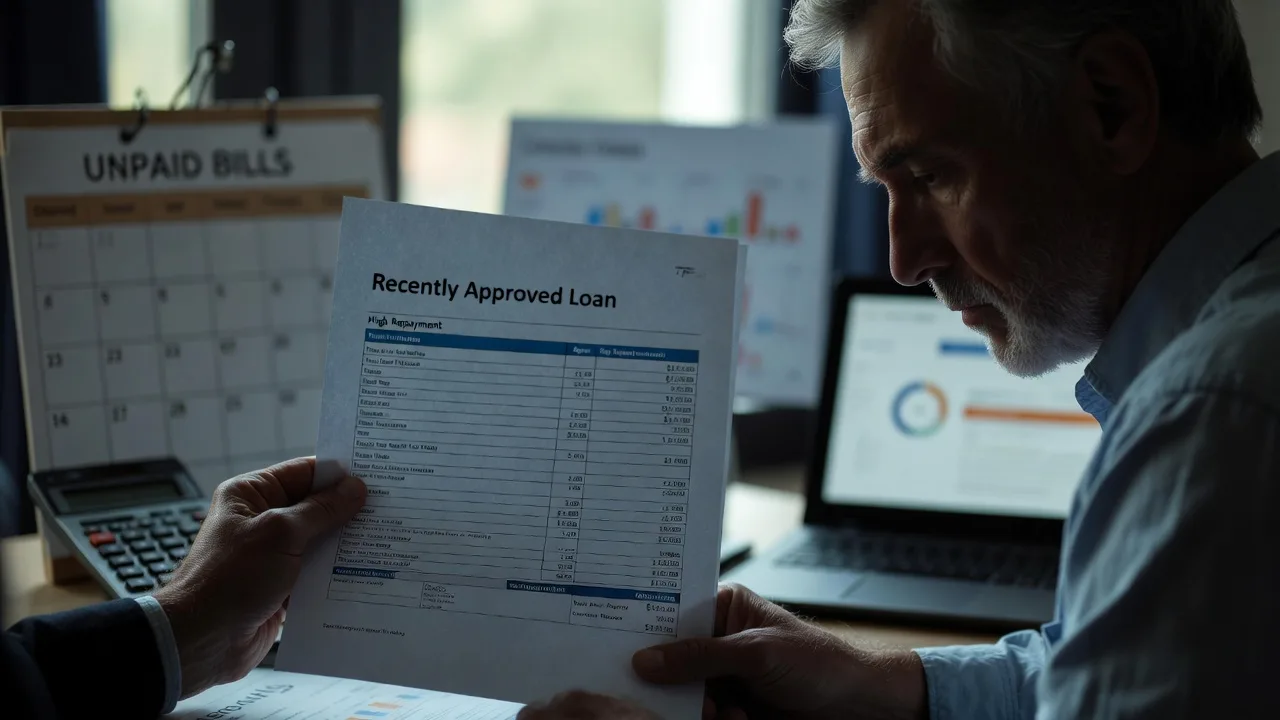
Not reading the fine print. Loan agreements contain important details about default triggers, cross-default clauses (defaulting on one loan triggers default on another), personal guarantee terms, and lender rights. Some agreements allow lenders to accelerate the loan (demand full immediate repayment) for minor covenant violations. Others automatically debit your bank account, potentially overdrawing it during cash flow crunches.
Applying to too many lenders at once. Each loan application may trigger a hard credit inquiry, which can temporarily lower your credit score. Multiple inquiries within a short period (14-45 days, depending on the credit scoring model) typically count as a single inquiry for mortgages and auto loans, but business loan inquiries don’t always receive this treatment. Space applications out and focus on lenders where you’re likely to qualify.
Choosing based on approval likelihood alone. Desperate business owners sometimes accept terrible terms just to get approved. A merchant cash advance at 70% APR might provide immediate cash, but the repayment structure can trap businesses in a cycle of expensive refinancing. If you can only qualify for extremely expensive financing, consider whether the business problem you’re solving is worth the cost or if alternative solutions (cutting expenses, finding equity investors, delaying the project) make more sense.
Mismatching loan term to use case. Short-term financing makes sense for temporary needs—bridging a seasonal cash flow gap or purchasing inventory for an upcoming busy period. Long-term debt suits permanent investments like real estate purchases or major facility renovations. A restaurant financing a kitchen remodel that will generate revenue for ten years should use a five- to seven-year loan, not a nine-month loan requiring huge monthly payments.
Compare small business loans example: A retail business owner needed $80,000 for inventory before the holiday season. She received three offers: a bank line of credit at 9% APR with a 60-day approval timeline, an online term loan at 18% APR funding in five days, and an MCA at 52% APR funding immediately. She chose the MCA because she needed funds within a week and didn’t think she’d qualify for the bank line.
The MCA required repaying $121,600 over nine months ($13,511 monthly). Holiday sales were strong, but the aggressive repayment schedule consumed most of her profit. She struggled to restock for spring and took another MCA at similar terms, starting a debt cycle. Had she planned ahead and applied to the bank two months earlier, or accepted the online loan at 18% (which would have cost $94,400 total over 24 months), she would have saved tens of thousands of dollars and maintained healthier cash flow.
FAQs
APR (Annual Percentage Rate) serves as the most reliable single metric because it captures your true annual expense including both interest charges and the majority of fees. That said, you also need to evaluate your payment schedule and how long you’ll be repaying. A loan with marginally higher APR but reasonable monthly obligations might work better than a lower APR option demanding aggressive daily or weekly payments that strain your available cash. Run the numbers on both your monthly commitment and your cumulative repayment amount to fully understand each loan’s financial impact.
Checking your own credit or getting prequalified with soft credit checks doesn’t affect your score. Formal loan applications typically trigger hard inquiries, which can temporarily lower your score by a few points. Multiple hard inquiries for the same type of loan within a short period (usually 14-45 days) often count as a single inquiry, though this protection is more reliable for mortgages and auto loans than business loans. Space applications strategically and apply only to lenders where you’re likely to qualify.
Merchant cash advances and revenue-based financing typically have the most accessible approval standards because they evaluate primarily your revenue flow and daily sales rather than your credit history or how long you’ve operated. Some providers approve businesses with credit scores under 600 or operating histories shorter than six months. This accessibility comes at a steep price—frequently 40-80% APR or higher. Businesses qualifying for traditional bank products, SBA loans, or even standard online term loans will pay substantially less despite facing more stringent approval requirements.
Comparing small business loans thoroughly can save thousands of dollars and prevent operational problems caused by unsuitable financing. The process requires understanding different loan types, evaluating multiple factors beyond interest rates, checking your qualifications against lender requirements, and systematically gathering and comparing quotes.
Start by defining your exact funding needs and matching them to appropriate loan products. Check your credit and financials to determine which lenders you should pursue. Gather quotes from at least three to five lenders across different categories. Calculate the total cost and monthly payment for each option, not just the advertised rate. Review terms carefully for hidden fees, prepayment penalties, and restrictive covenants.
Avoid common mistakes like focusing only on approval speed or interest rates while ignoring total cost and payment structure. Your financing timeline should reflect how long your purchased assets will generate business value. Read agreements carefully before signing.
The right loan provides capital at a manageable cost with terms that support your business operations and growth plans. The wrong loan can trap you in expensive debt cycles or create cash flow problems that threaten business viability. Taking time to compare options properly is one of the most valuable investments you can make in your business’s financial health.