

- What Is a Small Business Line of Credit?
- How a Small Business Line of Credit Works
- Requirements to Qualify for a Small Business Line of Credit
- Types of Small Business Lines of Credit
- The Application Process Step-by-Step
- Costs and Fees to Expect
- When to Use vs. Avoid a Business Line of Credit
- Comparison of Financing Options
Running short on cash happens to every business owner eventually. Your biggest client pays 60 days late. Equipment breaks down on a Friday. A supplier offers 15% off if you stock up this week. Traditional loans don’t work for these situations—by the time the bank approves funding, the opportunity’s gone or the problem’s gotten worse.
That’s where credit lines come in. Instead of borrowing a fixed amount all at once, you get approval for a maximum limit and take what you need, when you need it. You’ll only owe interest on money you’ve actually withdrawn. Once you pay it back, those funds become available to borrow again without filling out another application.
Think of it this way: a regular business loan hands you $50,000 today, charges interest on the full amount immediately, and that’s it—one transaction, done. A $50,000 credit line lets you grab $8,000 in March, another $12,000 in June, repay both by August, then borrow $20,000 in October. Same credit facility, used multiple times.
What Is a Small Business Line of Credit?
This financing product works as revolving credit—a pool of money you can tap repeatedly. The lender approves you for a specific maximum amount. You withdraw portions as needed, up to that ceiling.
Here’s what makes it different from standard loans: when you pay down your balance, that capacity refreshes automatically. Borrow $15,000 from your $40,000 line, pay back $10,000, and you’ve now got $35,000 available ($40,000 limit minus the $5,000 still outstanding).
Compare that to term loans, where you get a single lump sum upfront. Let’s say you take a $50,000 term loan. You’ll receive $50,000 on day one, start making payments immediately on the full $50,000, and once you’ve repaid it, you’re done. Want more money? Submit another application, go through underwriting again, wait weeks for approval.
With a $50,000 line, you might withdraw $10,000 in March to stock inventory, repay it by May, grab $15,000 in July for repairs, pay that off, then take $8,000 in November—all using the same pre-approved credit facility.
Business owners typically rely on credit lines for:
- Managing timing mismatches: Covering payroll when invoices haven’t cleared yet
- Seasonal inventory buildup: Stocking shelves before your busy season hits
- Equipment failures: Replacing broken machinery that can’t wait three weeks for loan approval
- Time-sensitive deals: Grabbing supplier discounts or bulk pricing before offers expire
- Receivables gaps: Bridging the lag between when you deliver services and when customers actually pay
Most lenders offer lines between $10,000 and $500,000, though some extend up to $1 million for businesses with exceptional financials. These facilities typically stay open for 12-24 months before renewal, though certain banks provide multi-year arrangements.

How a Small Business Line of Credit Works
Once approved, you’ll have a maximum borrowing capacity determined by your company’s revenue, credit profile, and financial stability. You can access these funds through online transfers, physical checks, or sometimes a dedicated debit card linked to the account.
Interest accumulates exclusively on whatever amount you’re currently carrying. Say you’ve been approved for a $100,000 facility but you’ve only taken $20,000—you’re paying interest on that $20,000, not the full credit limit. Lenders calculate charges either daily or monthly, depending on their policies. In 2026, expect APRs ranging from 7% to 25%, varying based on your qualifications and which type of lender you choose.
Repayment terms differ significantly across providers:
- Interest-only arrangements: During the draw window, some lenders want just interest payments, with the principal due when you renew or whenever you decide to pay it down
- Minimum required payments: Others mandate monthly minimums (frequently 1-3% of what’s outstanding) covering interest plus a slice of principal
- Pay-as-you-go flexibility: Many online platforms let you repay on whatever schedule works, provided you hit minimum requirements and don’t exceed your limit
Small Business Line of Credit Example
Picture a landscaping outfit with $75,000 in approved credit at 12% APR:
April: The owner withdraws $30,000 for spring equipment and materials before contracts start. Current outstanding amount: $30,000. Interest charges this month: roughly $300.
May: Finished jobs bring in revenue, allowing a $15,000 paydown. What’s still owed: $15,000. This month’s interest: approximately $150.
June: A major commercial project needs $40,000 upfront for materials and labor. The owner takes another $40,000. Total borrowed now: $55,000. Interest this month: around $550.
July-August: The commercial client pays in full, making it possible to wipe out the entire $55,000 balance. Current debt: $0. Interest charges: nothing.
September: The full $75,000 sits ready to use again whenever needed.
Across these five months, the business paid roughly $1,200-$1,500 in interest—only on amounts actually borrowed during specific timeframes. A $75,000 term loan would’ve triggered interest on the complete sum from day one, whether the money was needed or not.
Draw Period vs. Repayment Period
Certain credit lines split their lifespan into two distinct phases:
Draw window: Usually lasting 12-24 months, this is when you can borrow and pay back freely. You might only need to cover interest or make small minimum payments during this stretch. Withdraw funds, repay them, withdraw again—as many times as necessary.
Payback phase: Once the draw window closes, some facilities convert into term loan format. You lose the ability to take additional funds, and you’ll need to eliminate the outstanding balance over a defined timeline (commonly 6-12 months) through fixed monthly installments.
Not every credit line operates this way. Plenty of revolving facilities simply renew each year, maintaining continuous access as long as you’re meeting obligations. Before signing anything, confirm whether your agreement includes a separate repayment phase or renews automatically.
Requirements to Qualify for a Small Business Line of Credit
Lenders examine multiple factors when deciding approval and credit limits. Standards fluctuate substantially between traditional banks, online platforms, and credit unions.
Credit score thresholds:
- Big banks usually want personal credit scores hitting 680 minimum, plus business credit scores (FICO SBSS or Dun & Bradstreet Paydex) around 75 or better
- Online platforms might greenlight scores down to 600, though you’ll face steeper interest rates
- SBA-guaranteed lines generally seek 650+ personal scores
Revenue benchmarks:
- Banks frequently set minimum annual revenue at $250,000 to $500,000
- Online lenders sometimes work with companies bringing in $100,000 yearly
- Certain fintech providers focus on monthly cash flow instead of annual figures, wanting $25,000+ coming through each month
Operating history:
- Traditional banks prefer companies that have been operating at least two years
- Online lenders may consider businesses just six months old
- Startups lacking operating history face steep challenges qualifying, though a handful of lenders offer lines backed by personal collateral
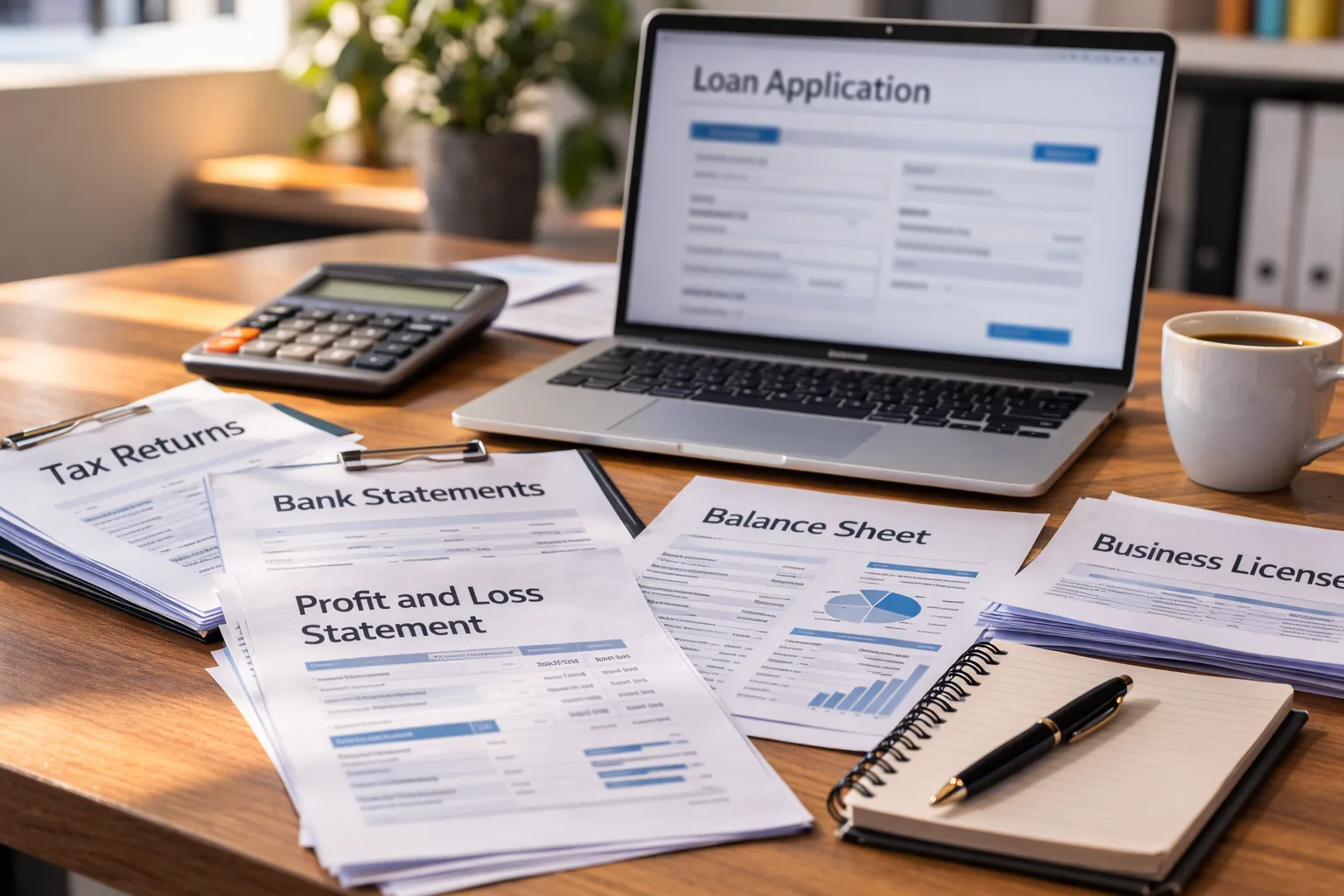
Paperwork you’ll need:
- Business and personal tax filings (typically covering two years)
- Bank statements (three to six months’ worth)
- Profit and loss reports
- Balance sheet documentation
- Business licenses and formation paperwork
- Accounts receivable aging schedules (for larger credit amounts)
Collateral factors:
Secured credit lines demand collateral—business equipment, property, inventory, or outstanding invoices. Banks often insist on security for amounts exceeding $100,000. Unsecured lines depend solely on creditworthiness but usually carry higher rates and lower limits.
Most lenders demand a personal guarantee regardless, creating personal liability even when no specific assets are pledged. You’ll be on the hook personally if your company defaults, even with an “unsecured” facility.
Types of Small Business Lines of Credit
Secured vs. Unsecured
Secured facilities require pledging assets: machinery, inventory, real estate, or receivables. Since lenders can claim these assets following default, they’ll charge lower interest rates and approve higher limits. You might see 8-14% APR with limits reaching $500,000 or beyond. The tradeoff: losing pledged assets becomes possible, and applications take longer due to appraisals and lien paperwork.
Unsecured facilities skip collateral requirements, relying completely on your credit and financial performance. Interest rates typically land between 12-25% APR, with limits often maxing out around $100,000-$250,000. Approval happens quicker, but personal guarantees still put your personal assets at risk despite no formal collateral.
Traditional Bank vs. Online Lender vs. SBA Options
Traditional banks (Chase, Bank of America, Wells Fargo, regional institutions):
– Rock-bottom interest rates (7-12% APR for strong applicants)
– Highest possible limits ($250,000-$1,000,000)
– Toughest qualification hurdles
– Slowest approval timelines (2-6 weeks)
– Best fit for established companies with solid credit and existing relationships
Online lenders (Bluevine, Fundbox, OnDeck, Kabbage):
– Moderate to steep interest rates (12-25% APR)
– More modest limits ($10,000-$250,000)
– Relaxed qualification standards
– Rapid approval (1-3 days)
– Best fit for newer businesses or those with credit blemishes
SBA credit lines:
– The SBA CAPLines program backs credit lines through partner lenders
– Competitive pricing (usually 8-13% APR)
– Limits reaching $5 million
– Demands strong qualifications and substantial documentation
– Approval stretches 4-8 weeks
– Best fit for businesses qualifying for SBA programs needing larger amounts
Industry-Specific Lines
Certain lenders design specialized lines for particular sectors:
- Invoice financing lines: Advance cash against unpaid invoices, especially useful for B2B service providers
- Inventory lines: Secured by stock, tailored for retail and wholesale operations
- Seasonal lines: Built around predictable seasonal patterns for agriculture, tourism, or holiday-dependent retail
- Construction lines: Short-term facilities aligned with specific project schedules

The Application Process Step-by-Step
Step 1: Pre-qualification
Most lenders provide soft-pull pre-qualification that gauges your approval likelihood without dinging your credit score. You’ll share basic details: revenue figures, operating duration, approximate credit score, and how much credit you want. Pre-qualification takes 5-15 minutes and shows whether you’re in the ballpark.
Step 2: Documentation gathering
Before launching formal applications, collect required paperwork. Missing documents cause the majority of delays. Build a digital folder containing:
- Two years of business and personal tax filings
- Six months of business bank statements
- Current profit and loss reports
- Balance sheet
- Formation documents (LLC operating agreement, incorporation certificates, etc.)
- Business licenses
- Personal financial statement listing assets and liabilities
Step 3: Formal application
Submit applications to 2-3 lenders for comparison. Formal applications trigger hard credit inquiries, which might temporarily drop your credit score a few points. Multiple inquiries bunched within a 14-30 day span typically count as one inquiry for scoring.
Complete applications truthfully and precisely. Inconsistencies between applications and supporting documents raise alarms and drag out underwriting.
Step 4: Underwriting timeline
- Online lenders: 1-3 business days
- Traditional banks: 2-6 weeks
- SBA lines: 4-8 weeks
During this phase, lenders might request extra documentation or clarification. Quick responses on your end prevent timeline extensions.
Step 5: Approval and setup
Following approval, you’ll receive a credit agreement specifying:
- Your credit ceiling
- Interest rate and calculation methodology
- All fees (draw fees, maintenance charges, yearly fees)
- Repayment terms
- Draw period and renewal conditions
- Default provisions
Review this agreement thoroughly. Watch especially for variable rate language (rates that can climb), renewal stipulations, and circumstances letting the lender cut your limit or demand immediate full repayment.
After executing the agreement, the lender creates your account, taking 1-3 days for online lenders or potentially a week for banks.
Step 6: First draw
Once active, you can make your initial withdrawal. Some lenders mandate an initial draw within 30-90 days; others let the line sit unused indefinitely. Clarify any mandatory draw requirements before committing.
Costs and Fees to Expect
Total cost extends well beyond the advertised interest rate. Factor in every fee when comparing offers.
Interest rates by lender type (2026 ranges):
- Traditional banks: 7-12% APR for prime candidates
- Credit unions: 8-13% APR for members
- Online lenders: 12-25% APR depending on your profile
- Alternative lenders: 18-35% APR for riskier borrowers
Rates come as fixed or variable. Variable rates pegged to the prime rate can climb over time, increasing your costs even with identical balances.
Draw fees: Certain lenders charge 1-3% each time you take funds. Withdrawing $10,000 with a 2% draw fee immediately costs $200. Frequent small withdrawals make these fees pile up fast.
Maintenance fees: Monthly or quarterly charges (typically $20-$100) for keeping the line open, assessed whether you use it or not. A $50 monthly maintenance fee totals $600 yearly even if you never touch the credit.
Annual fees: Some lenders impose yearly charges ($100-$500) for larger facilities, functioning like credit card annual fees.
Inactivity fees: A handful of lenders penalize you for not drawing funds within certain timeframes, though these appear less frequently.
Early closure penalties: Shutting down your line within the first 12-24 months might trigger penalties ($250-$500), designed to recover origination costs.
Origination fees: Some lenders charge upfront fees (1-5% of your limit) to establish the facility. A $100,000 line with 3% origination costs $3,000 before you withdraw anything.
A line advertising 12% interest but charging 2% draw fees plus $50 monthly maintenance might cost more than a 15% rate with zero additional fees, depending on how you use it. Calculate total costs based on your expected draw patterns and amounts.

When to Use vs. Avoid a Business Line of Credit
Best use scenarios:
Cash flow timing issues: When customers drag their feet paying while your bills come due, credit lines bridge the gap without forcing you to skip payroll or bounce rent checks. This represents the textbook scenario these products solve better than alternatives.
Seasonal inventory buildup: Retailers stocking before holidays, landscapers buying equipment before spring rushes, or farms purchasing seed and supplies benefit from drawing funds for inventory, then clearing balances once seasonal revenue arrives.
Emergency expenses: Broken equipment, sudden repairs, or unexpected opportunities (like a competitor liquidating inventory at 40% off) demand fast capital access. Having pre-approved credit means acting immediately instead of waiting weeks for loan approval.
Time-sensitive deals: Supplier early-payment discounts, bulk purchase savings, or limited-window offers frequently save more than the interest costs of short-term borrowing.
Managing scattered expenses: Rather than applying for separate loans repeatedly, credit lines handle various small to medium expenses year-round through a single facility.
When term loans work better:
- Major one-time acquisitions: Purchasing real estate, significant equipment, or acquiring another business works better with term loans’ lower rates and predictable repayment schedules
- Extended financing timeframes: Needing capital for 3-5 years means term loan rates beat credit line pricing
- Lower rates available: Well-qualified borrowers often lock in term loans at 6-10% versus 12-18% for credit lines
When business credit cards work better:
- Small purchases: For expenses under $5,000, business cards offer rewards programs, simpler tracking, and comparable flexibility
- Rewards maximization: If you can eliminate balances monthly, card rewards outweigh credit line benefits
When to skip lines of credit entirely:
- Masking ongoing losses: If your company consistently burns more cash than it generates, credit lines temporarily hide the problem while making it worse
- Startup funding: Most lenders reject businesses without operating history; using personal credit for business startup creates dangerous personal exposure
- Real estate acquisitions: Credit lines weren’t designed for large, permanent asset purchases
- Costs strain your budget: If maintenance fees and interest charges stress your finances, you’re not positioned for this tool yet
Expert perspective:
A line of credit functions as financial insurance for small businesses. The businesses that benefit most are those who establish the line before they need it. Applying during a cash crunch weakens your negotiating position and may result in denial. Set up your line when business is strong, then use it strategically for short-term needs. The businesses that struggle are those treating their line like permanent working capital rather than a temporary bridge.
Jennifer Martinez
Comparison of Financing Options
| Feature | Line of Credit | Term Loan | Business Credit Card |
|---|---|---|---|
| Funding amount | $10K-$500K+ | $25K-$5M+ | $5K-$100K |
| How repayment works | Revolving; interest charges only on outstanding balance | Set monthly installments | Revolving; required minimum payments |
| Interest rates | 7-25% APR | 6-15% APR | 13-25% APR |
| Ideal scenarios | Timing gaps, seasonal buildups, urgent needs | Major acquisitions, expansion projects, equipment | Small expenses, tracking tools, earning rewards |
| Difficulty qualifying | Moderate | Moderate to challenging | Easy to moderate |
| Speed to funding | 1-6 weeks | 2-8 weeks | Instant to 2 weeks |
| Reuse capability | Reusable as balance gets paid down | Single disbursement only | Reusable as balance gets paid down |
FAQs
Big banks typically want personal credit scores hitting 680 minimum. Online platforms may greenlight scores down to 600, though anything below 650 triggers significantly higher rates. Your business credit score (if you’ve established one) also factors in—banks prefer scores above 75 on the FICO SBSS scale or 80+ on Paydex. Scores under 600 make approval unlikely without substantial collateral or exceptional revenue.
Limits usually span $10,000 to $500,000 for most small companies, with some banks extending up to $1 million for established operations with stellar financials. Lenders commonly cap your line at 10-20% of yearly revenue. A company generating $500,000 annually might qualify for $50,000-$100,000. Your credit history, operating duration, and collateral (for secured facilities) influence the final ceiling.
Interest charges apply exclusively to your current outstanding balance. With a $100,000 facility but only $25,000 withdrawn, interest accumulates on that $25,000. Pay back that $25,000 and interest charges stop. This separates credit lines from term loans, where interest starts accruing on the full amount immediately. However, watch for maintenance charges—you might owe these even carrying a zero balance.
Yes, unsecured business credit lines skip collateral requirements entirely. Online lenders and certain banks offer unsecured facilities up to $100,000-$250,000 based on creditworthiness, revenue, and operating history. Expect steeper interest rates (typically 12-25% versus 8-14% for secured facilities) and tougher qualification standards. Most unsecured lines still demand a personal guarantee, creating personal liability despite no pledged assets.
Online platforms frequently approve applications within 1-3 business days, with funds accessible shortly after. Traditional banks need 2-6 weeks due to more extensive underwriting and documentation verification. SBA-backed lines require 4-8 weeks. Pre-qualification (which doesn’t guarantee approval) takes just minutes with most providers. Incomplete paperwork causes most delays—having everything organized before applying dramatically accelerates the timeline.
Formal applications trigger hard credit inquiries, potentially lowering your score 2-5 points temporarily. This impact fades within a few months and stops affecting scoring calculations within a year. Pre-qualification relies on soft inquiries that don’t touch your score. Multiple applications bunched within 14-30 days typically count as one inquiry for scoring purposes, so comparing several lenders simultaneously minimizes credit impact. Your payment behavior on the credit line affects your score far more significantly—timely payments help, late payments damage it substantially.
Few financing options match the flexibility credit lines deliver. Being able to access capital on demand, owing interest exclusively on amounts you’ve withdrawn, and reusing the facility as you eliminate balances makes it perfect for handling cash flow fluctuations, seasonal demands, and surprise expenses.
The secret to using credit lines effectively involves matching the tool to the situation. Short-term gaps, opportunistic purchases, and emergency scenarios justify the costs. Funding ongoing losses, making large permanent investments, or covering expenses you can’t realistically repay doesn’t.
Before applying anywhere, clarify your actual needs. Calculate how much you’ll likely withdraw, how quickly you can repay it, and how frequently you’ll tap the facility. Compare total costs—interest plus every fee—across multiple providers. Review the credit agreement meticulously, watching for variable rates, renewal stipulations, and circumstances allowing the lender to slash your limit or demand immediate full repayment.
For businesses facing revenue fluctuations, unpredictable costs, or seasonal patterns, a properly managed credit line delivers security and flexibility worth considerably more than its expense. For companies with stable cash flow and rare capital needs, simpler options might serve better.
The strongest position: establish your facility when you don’t desperately need it, maintain it responsibly, and withdraw only for expenses generating returns exceeding borrowing costs. Used this way, a business credit line becomes a strategic advantage instead of a financial burden.